mercury.planets.im
The closest planet to the Sun has a day longer than its year — and ice in the shadows.
NASA Science is clear: Mercury is the smallest planet, and the nearest to the Sun, and it is still not the hottest world in the solar system. The official fact sheet, and the same facts page, then disagree in the useful way — rounded wording beside tabulated figures, not instead of them.
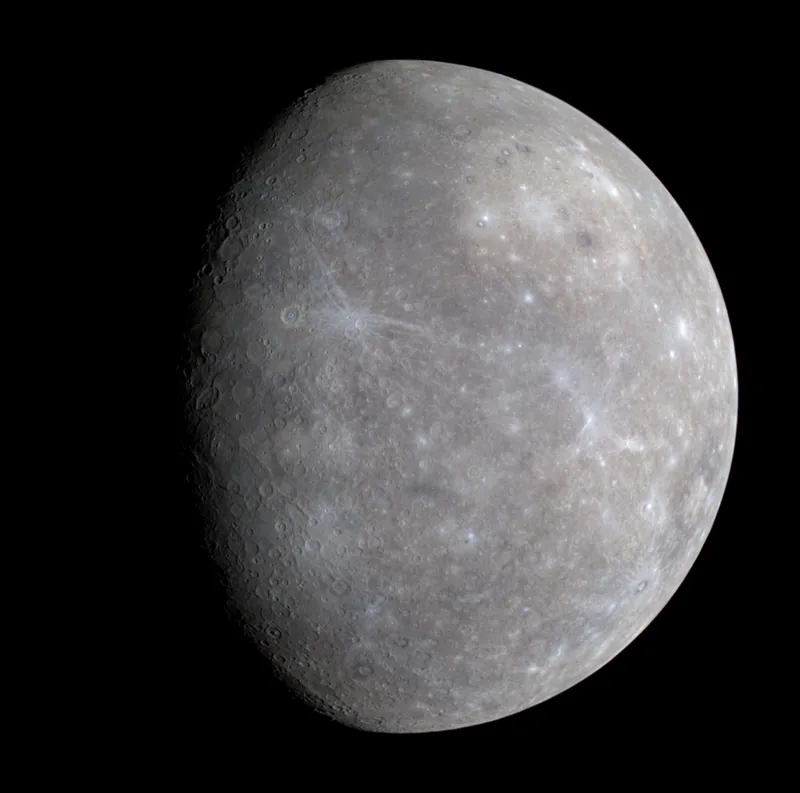
A small world that is not what the short version says
Mercury is the smallest planet in the solar system and the nearest to the Sun. NASA Science says so at the top of its facts page. [source] It is also, on the same official page, not the hottest planet. That title belongs to Venus, thanks to a dense atmosphere. Closest is not the same as hottest. The surprises do not stop there.
The NASA / NSSDCA Mercury Fact Sheet, curated by Dr David R. Williams, gives the volumetric mean radius as 2,439.7 km, a Mercury/Earth ratio of 0.383, and a mass ratio of 0.0553. [source] NASA Science's public wording is a radius of 1,516 miles (2,440 kilometres), a little more than 1/3 the width of Earth. The two official accounts sit side by side on this desk; they are not flattened into one number.
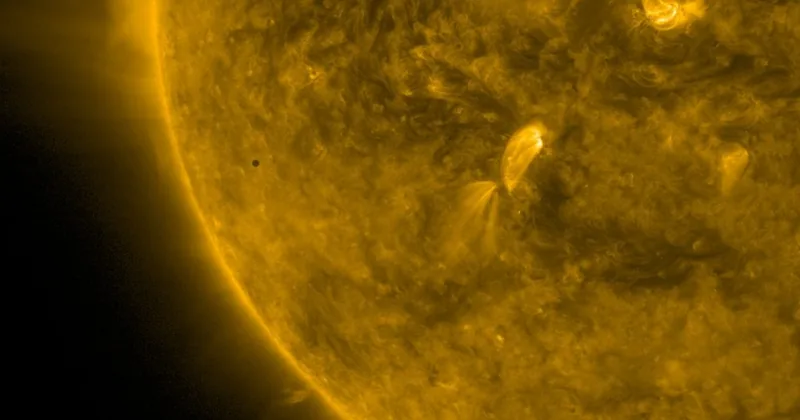
From some parts of the surface, NASA Science says, the morning Sun appears to rise briefly, set, and rise again. A solar day — one full day-night cycle — lasts 176 Earth days on that page, just over two years on Mercury. The fact sheet's length of day is 4,222.6 hours, a ratio of 175.942 against Earth's 24-hour day, and the sidereal year is 87.969 days. [source] A day, in other words, that is longer than a year.
And yet there is ice
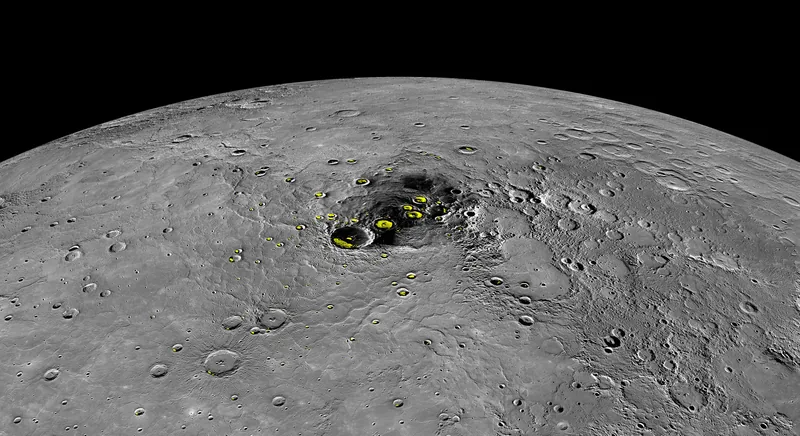
NASA Science says Mercury may have water ice at its north and south poles inside deep craters, but only in regions in permanent shadows. [source] A MESSENGER still, released as PIA19411, marks those radar-bright deposits in yellow on a view of the north pole. The yellow is evidence from Arecibo, not a photograph of the ice.
A day longer than a year
87.969 days, 1,407.6 hours, and 4,222.6 hours — with NASA Science's rounded wording kept beside the fact sheet.
Hollows, scarps and Caloris
An unexpected landform, a shrinking world, and a basin 1,550 kilometres across.
Mariner 10 and MESSENGER
A first grainy crescent in 1974, and the first spacecraft to orbit the innermost planet.
Myths versus facts
Hottest? A two-degree tilt? What the eye would see in a false-colour basin?
Enjoyed a day longer than a year, ice in the shadows, and hollows no one had named until MESSENGER looked closely?
No pop-ups. No intrusive advertising. Just interesting stuff. A little support helps the next planets.im site get built.