A short history of close looks
A prehistoric wanderer, a 1974 crescent, and a first orbit
The official fact sheet calls the discoverer unknown and the discovery prehistoric. The first close photograph is dated 24 March 1974. The first look at the unseen side had to wait for MESSENGER.
The fact sheet's observational line for a discoverer is Unknown, and the discovery date is Prehistoric. [source] Mercury has been a morning and evening star for as long as people have watched the sky. What nobody had, until the 1970s, was a close look.
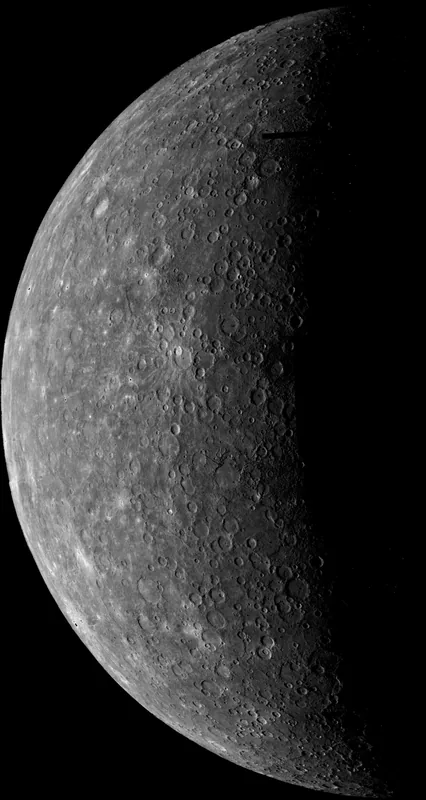
Mariner 10's first image of Mercury was acquired on 24 March 1974, from 3,340,000 miles (5,380,000 km). The official file caption gives the planet's diameter as 3,031 miles. It is a small, half-lit disk in a great deal of black — a first greeting, not a map. The spacecraft went on to make three flybys. Even then, because of the way those passes lined up, a large fraction of the surface stayed in the dark. For more than thirty years the unseen side of Mercury was a genuine blank on the atlas.
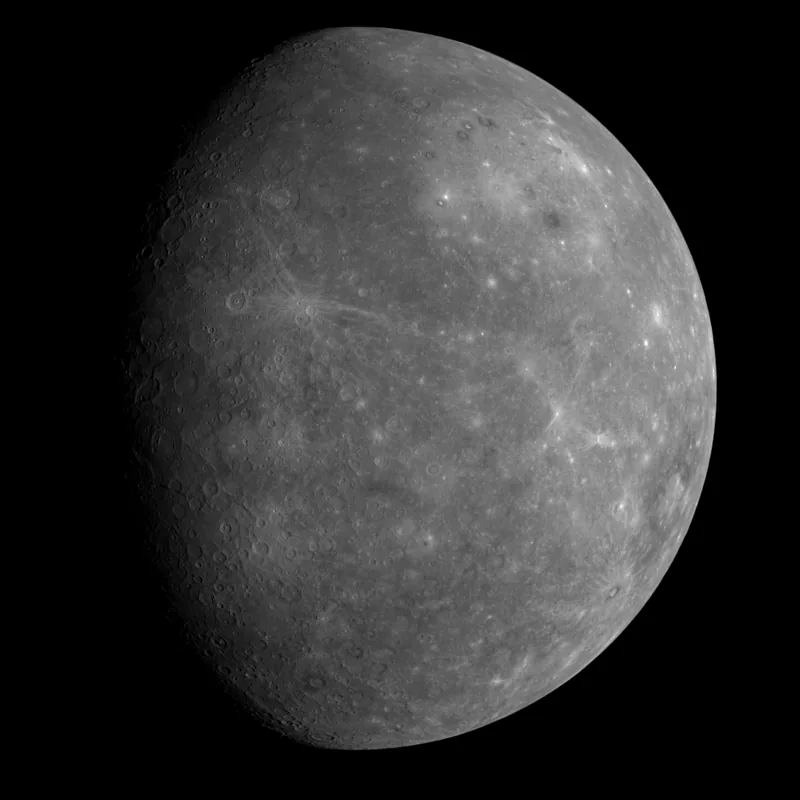
The first photograph of the unseen side
MESSENGER — MErcury Surface, Space ENvironment, GEochemistry, and Ranging — was the first spacecraft ever to orbit Mercury. A NASA Science resource about hollows, and the mission captions on the 2011 press-briefing stills, both say so. Before the orbital campaign there were flybys. The still above is the first MESSENGER photograph of the side Mariner 10 never saw: the moment the blank started to fill.
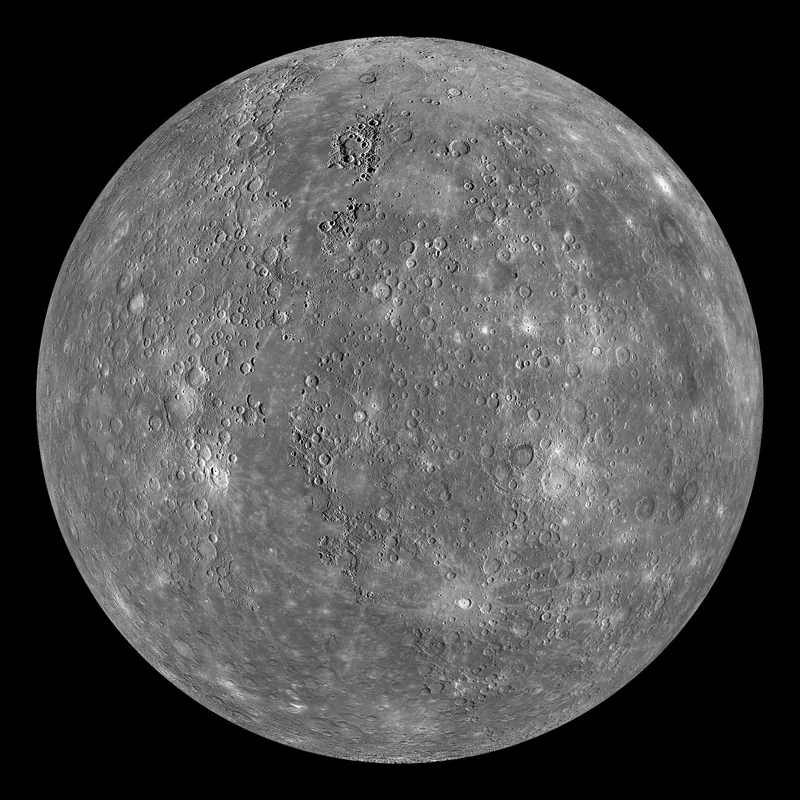
From orbit the planet became a place with a geology, not just a badly lit rust-grey ball. Hollows were presented at a NASA press briefing on 29 September 2011 and described the following February as a discovery of the orbital images. [source] The north-polar radar overlay, PIA19411, is dated 16 April 2015. The long scarps, the Caloris mosaics, and the global map centred at 0 degrees north, 0 degrees east, are all gifts of that campaign.
NASA Science's structure section puts a figure on why Mercury was worth the trouble: a metallic core about 85% of the planet's radius, with evidence that it is partly molten, and a magnetic field offset relative to the equator, only about 1% the strength of Earth's at the surface, that still interacts with the solar wind. [source] The fact sheet gives a MESSENGER Model 2010 dipole offset of 0.17 Rh and a surface field of 0.0025-0.007 Gauss, against a terrestrial surface field, on the Earth fact sheet, of 0.24-0.66 Gauss. [source] Official numbers, from official models, and still a planet that should not, at a lazy glance, have a magnetic field at all — it spins slowly, and it is small — and yet it has one.
The clocks those missions were circling are on the day desk. The ice in the polar shadows is on the ice page.
Enjoyed a day longer than a year, ice in the shadows, and hollows no one had named until MESSENGER looked closely?
No pop-ups. No intrusive advertising. Just interesting stuff. A little support helps the next planets.im site get built.