Signature desk
A day longer than a year
The official fact sheet and NASA Science are talking about the same clocks. One gives 87.969 days, 1,407.6 hours and 4,222.6 hours. The other says 88, 59 and 176 Earth days. This desk uses the tabulated figures for the drawings, and keeps the rounded wording in the room.
A day longer than a year
Three official clocks, and none of them is a day on Mercury on its own. The fact sheet separates a sidereal orbit period, a sidereal rotation period, and a length of day. [source] NASA Science's facts page gives the same kinds of number in rounded public wording: 88 Earth days, 59 Earth days, and 176 Earth days. [source]
Why a day can last more than a year
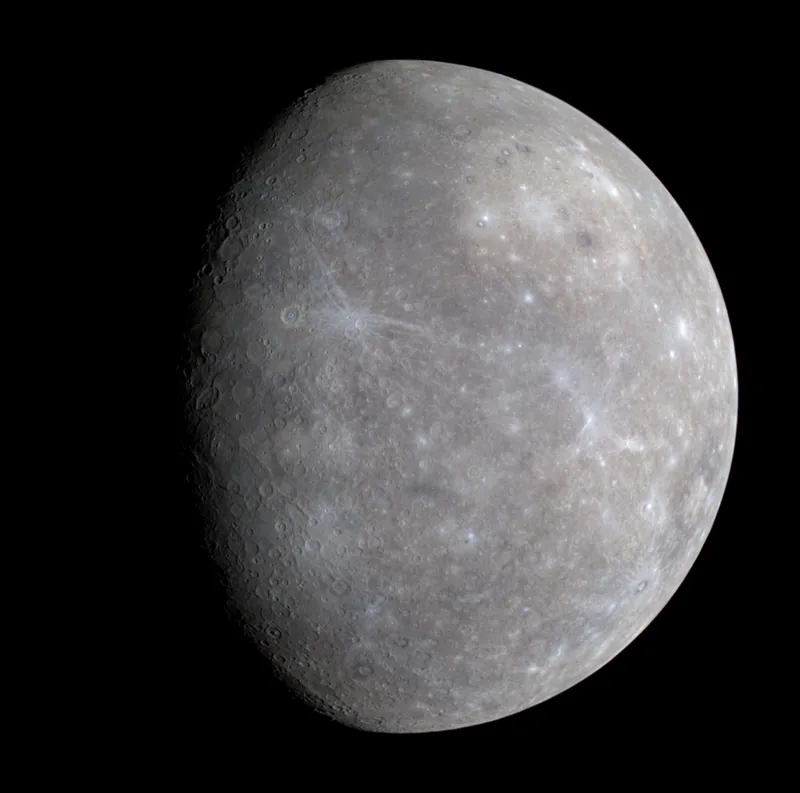
On Earth the two ideas feel interchangeable. Here they come apart. Mercury has to spin on its axis and travel around the Sun. The spin, on the fact sheet, takes 1,407.6 hours. The trip around the Sun takes 87.969 days. Because the planet is moving along a markedly eccentric orbit while it spins, the Sun takes much longer to return to the same place in the local sky. That is the length of day: 4,222.6 hours.
NASA Science adds a stranger detail, tied to the stretch of the orbit. Mercury's path takes it as close as 29 million miles (47 million kilometres) and as far as 43 million miles (70 million kilometres) from the Sun. The fact sheet's perihelion and aphelion are 46.000 and 69.818 × 10⁶ km. [source] When Mercury is moving fastest, and is closest to the Sun, each rotation is not accompanied by sunrise and sunset like it is on most other planets. The morning Sun, on that official page, appears to rise briefly, set, and rise again from some parts of the surface. The same thing happens in reverse at sunset.
Almost no tilt — with two official wordings
The fact sheet gives the obliquity to orbit as 0.034 degrees. [source] NASA Science says the axis of rotation is tilted just 2 degrees with respect to the plane of its orbit around the Sun, and that Mercury spins nearly perfectly upright and so does not experience seasons as many other planets do. [source] Those two official wordings are not the same number. This desk does not average them, and it does not pick a favourite. They are kept distinct, as the sources wrote them.
The year, the spin and the solar day are on the facts list, and the rounded-versus-tabulated habit is a regular guest in Useless's field notes.
Enjoyed a day longer than a year, ice in the shadows, and hollows no one had named until MESSENGER looked closely?
No pop-ups. No intrusive advertising. Just interesting stuff. A little support helps the next planets.im site get built.