Field notes
Useless's field notes
Official wording, kept distinct. A few pictures that would mislead without their captions.
Useless has been walking the official pages with a pencil. These are the places where two good sources do not say quite the same thing, or where a picture is doing a job that a casual glance would misread.
0.034 degrees, and just 2 degrees
The fact sheet's obliquity to orbit is 0.034 degrees. [source] NASA Science says the axis is tilted just 2 degrees. [source] That is not rounding of the same figure in any ordinary sense. Both pages were opened on 18 November 2026. Both wordings stay on this site. No average is offered as a third fact.
87.969 and 88; 1,407.6 hours and 59 days; 4,222.6 hours and 176 days
These are the friendly kind of difference. The fact sheet tabulates; NASA Science rounds for a public facts page. The desk drawings use the tabulated figures. The rounded wording sits beside them, not over them.
2,439.7 km and 2,440 kilometres
The fact sheet's volumetric mean radius is 2,439.7 km; the equatorial radius is 2,440.5 km. NASA Science gives a radius of 1,516 miles (2,440 kilometres). Close, and not identical, and not a reason to pick one and hide the other.
6.674 and as much as seven times
Solar irradiance on the fact sheet is 9,082.7 W/m2 against 1,361.0, a ratio of 6.674. NASA Science says sunlight would be as much as seven times brighter. Same comparison, rounded differently.
Temperatures the fact sheet does not tabulate in the same way
NASA Science's 800°F (430°C) day and -290°F (-180°C) night are public wording on the facts page. The fact sheet's average is 440 K (167°C), with a sunward-side range of 590-725 K. The night-side extreme is not treated here as if it had come from the same table.
Exosphere lists
NASA Science: mostly oxygen, sodium, hydrogen, helium and potassium. The fact sheet gives column abundances, with sodium, magnesium and oxygen among the named species, and notes that values can vary with local time or location. The lists are not merged into one atmosphere.
Pictures that need a label
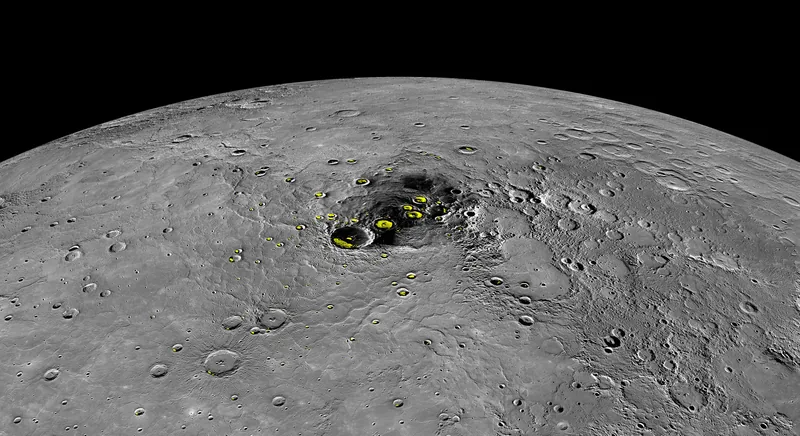
PIA10359 is false colour. PIA19421 is enhanced colour. PIA19411's yellow is radar evidence. The SDO transit still is a spacecraft image of the Sun, and official pages say never to look directly at the Sun without protecting your eyes. Captions on this site say those things out loud.
Enjoyed a day longer than a year, ice in the shadows, and hollows no one had named until MESSENGER looked closely?
No pop-ups. No intrusive advertising. Just interesting stuff. A little support helps the next planets.im site get built.