Questions
Questions people actually ask
Short answers, from official pages, with the rounding left visible.
Is Mercury the hottest planet?
No. NASA Science says that title belongs to Venus, thanks to its dense atmosphere, even though Mercury is closer to the Sun. [source]
How long is a day on Mercury?
It depends which official clock you mean. The fact sheet's sidereal rotation is 1,407.6 hours; the length of day is 4,222.6 hours; the year is 87.969 days. [source] NASA Science rounds those to 59, 176 and 88 Earth days. [source]
Can there really be ice so close to the Sun?
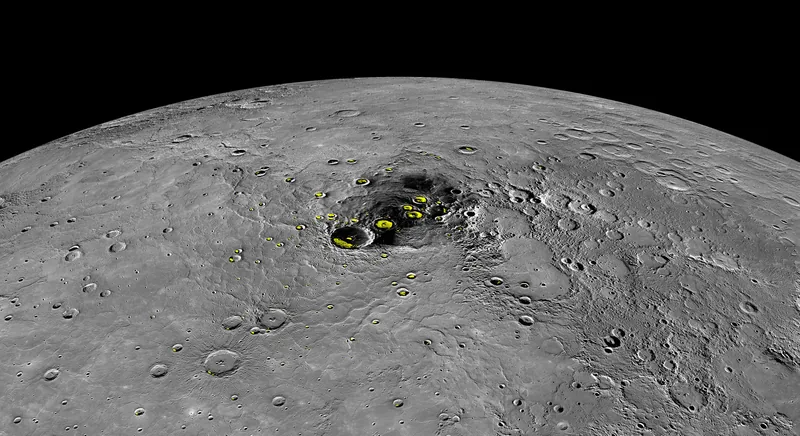
NASA Science says Mercury may have water ice at both poles, but only in regions in permanent shadow. [source] A MESSENGER map marks radar evidence from Arecibo in yellow. That yellow is not a photograph of the ice.
What are hollows?
A NASA Science resource dated 29 February 2012 says MESSENGER discovered strange hollows: thousands of peculiar depressions, from 60 feet to over a mile across and 60 to 120 feet deep. [source] Official captions from a 29 September 2011 briefing call them an unexpected landform whose formation may involve the loss of volatile material.
Does Mercury have an atmosphere?
The fact sheet calls it a surface-bounded exosphere, essentially a vacuum, with surface pressure <~5 × 10-15 bar. [source] NASA Science describes a thin exosphere of atoms blasted off the surface by the solar wind and striking meteoroids. [source]
Does Mercury have moons or rings?
No. The fact sheet lists zero natural satellites and no ring system. NASA Science says the same in two short sentences.
Why is Mercury so dense?
NASA Science calls it the second densest planet after Earth, with a metallic core about 85% of the planet's radius. [source] The fact sheet's density ratio to Earth is 0.985. [source]
Who discovered Mercury?
The fact sheet says the discoverer is unknown and the discovery date is prehistoric. [source] It has been known as a wanderer in the sky far longer than it has been known as a cratered world with hollows and polar ice.
Enjoyed a day longer than a year, ice in the shadows, and hollows no one had named until MESSENGER looked closely?
No pop-ups. No intrusive advertising. Just interesting stuff. A little support helps the next planets.im site get built.