Official figures
Facts, with the official wording left intact
The fact sheet is for tabulated figures. NASA Science is for the public wording, often rounded. This list does not pick a winner when they differ.
Figures from the NASA / NSSDCA Mercury Fact Sheet are labelled as such. [source] Rounded public wording from NASA Science's Mercury facts page is labelled as such. [source] Where the two differ, both are kept.
- Place in the solar system
- NASA Science: the smallest planet, and the nearest to the Sun; named for the swiftest of the ancient Roman gods; no moons; no rings.
- Volumetric mean radius
- Fact sheet: 2,439.7 km (Earth 6,371.0 km), ratio 0.383. Equatorial radius 2,440.5 km. NASA Science: a radius of 1,516 miles (2,440 kilometres), a little more than 1/3 the width of Earth.
- Mass
- Fact sheet: 0.33010 × 1024 kg, Mercury/Earth ratio 0.0553.
- Volume ratio
- Fact sheet: 0.0562.
- Mean density
- Fact sheet: 5,429 kg/m3 (Earth 5,513), ratio 0.985. NASA Science: the second densest planet, after Earth.
- Surface gravity (mean)
- Fact sheet: 3.70 m/s2 (Earth 9.82), ratio 0.378. Escape velocity 4.3 km/s.
- Core
- NASA Science: a large metallic core about 1,289 miles (2,074 kilometres) in radius, about 85% of the planet's radius; outer shell about 400 kilometres (250 miles) thick; evidence it is partly molten or liquid.
- Semimajor axis
- Fact sheet: 57.909 × 10⁶ km. NASA Science: an average distance of 36 million miles (58 million kilometres), 0.4 astronomical units, with sunlight taking 3.2 minutes to travel from the Sun.
- Perihelion and aphelion
- Fact sheet: 46.000 and 69.818 × 10⁶ km, eccentricity 0.2056. NASA Science: as close as 29 million miles (47 million kilometres) and as far as 43 million miles (70 million kilometres); a highly eccentric, egg-shaped orbit.
- Year (sidereal orbit period)
- Fact sheet: 87.969 days, ratio 0.241. NASA Science: every 88 Earth days, faster than any other planet, at nearly 29 miles (47 kilometres) per second. Fact sheet mean orbital velocity: 47.36 km/s.
- Sidereal rotation
- Fact sheet: 1,407.6 hours, ratio 58.785. NASA Science: one rotation every 59 Earth days.
- Length of day (solar day)
- Fact sheet: 4,222.6 hours, ratio 175.942. NASA Science: one Mercury solar day equals 176 Earth days, just over two years on Mercury.
- Obliquity
- Fact sheet: 0.034 degrees. NASA Science: tilted just 2 degrees, so it spins nearly perfectly upright and does not experience seasons as many other planets do. Both official wordings are kept; they are not the same number.
- Solar irradiance
- Fact sheet: 9,082.7 W/m2 (Earth 1,361.0), ratio 6.674. NASA Science: sunlight as much as seven times brighter than at Earth; the Sun would appear more than three times as large.
- Temperatures
- NASA Science: day highs of 800°F (430°C); night lows of -290°F (-180°C). Fact sheet: average 440 K (167°C); sunward side 590-725 K. The night-side extremes are not in the fact-sheet table; they are not treated here as the same figure.
- Exosphere
- Fact sheet: a surface-bounded exosphere, essentially a vacuum; surface pressure <~5 × 10-15 bar; column abundances listed for sodium, magnesium, oxygen and others. NASA Science: a thin exosphere of atoms blasted off the surface by the solar wind and striking meteoroids, composed mostly of oxygen, sodium, hydrogen, helium and potassium. The two composition lists are not merged.
- Magnetic field
- NASA Science: offset relative to the equator; at the surface just 1% the strength of Earth's. Fact sheet (MESSENGER Model 2010): dipole offset 0.17 Rh; surface field 0.0025-0.007 Gauss.
- Natural satellites and rings
- Fact sheet: 0 satellites; no ring system. NASA Science: Mercury doesn't have moons; Mercury doesn't have rings.
- Caloris and Rachmaninoff
- NASA Science: Caloris 960 miles (1,550 kilometres) in diameter; Rachmaninoff 190 miles (306 kilometres).
- Appearance to the eye
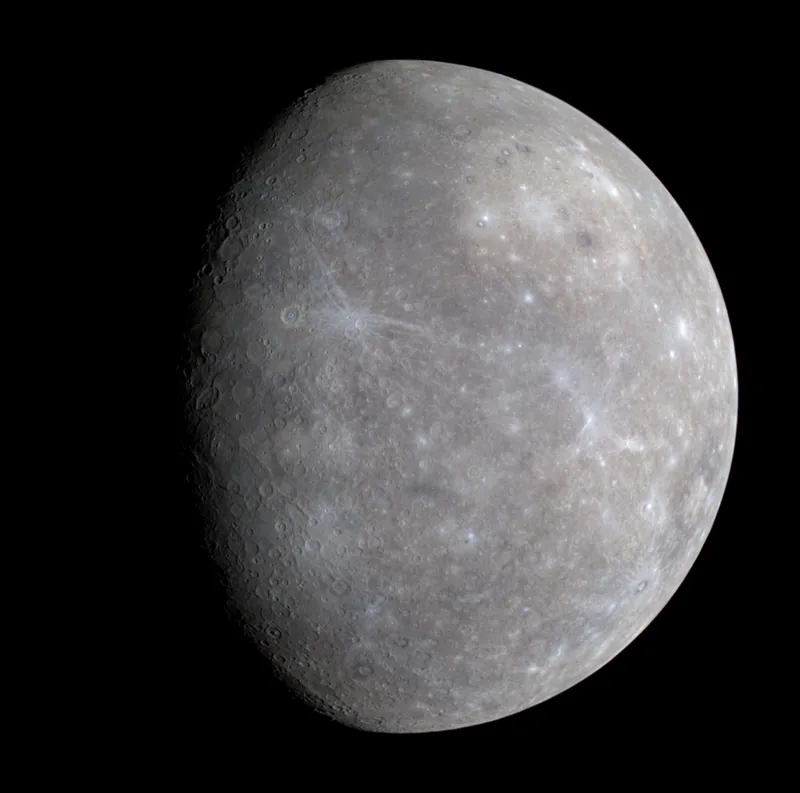
- NASA Science: most of the surface would appear greyish-brown to the human eye; bright streaks are crater rays.
Enjoyed a day longer than a year, ice in the shadows, and hollows no one had named until MESSENGER looked closely?
No pop-ups. No intrusive advertising. Just interesting stuff. A little support helps the next planets.im site get built.