The surface
Hollows, a shrinking crust, and a basin called Caloris
An unexpected landform in orbital pictures, cliffs raised as the interior cooled, and a false-colour look at a giant impact — with a monochrome mosaic of the same basin kept beside it.
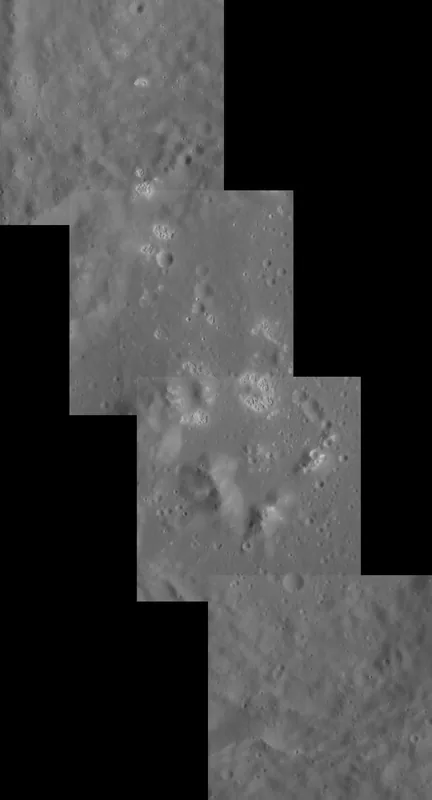
NASA's MESSENGER spacecraft discovered strange hollows on the surface of Mercury. That is the wording of a NASA Science resource dated 29 February 2012. Images taken from orbit, it says, reveal thousands of peculiar depressions at a variety of longitudes and latitudes, ranging in size from 60 feet to over a mile across and 60 to 120 feet deep. [source] The still above is a Narrow Angle Camera mosaic of hollows inside Truffaut crater. They look, even before anyone names the process, like a surface that has been etched.
A MESSENGER photojournal still of the Raditladi basin, presented at a NASA press briefing on 29 September 2011, calls hollows an unexpected landform found in high-resolution images, and says their formation may involve the loss of volatile material. Another still from the same briefing, of Sander crater, says the bright portions of the floor consist of large numbers of shallow irregular depressions, giving an etched appearance to the surface. Those are official captions, not a finished theory. This desk leaves the may in place.
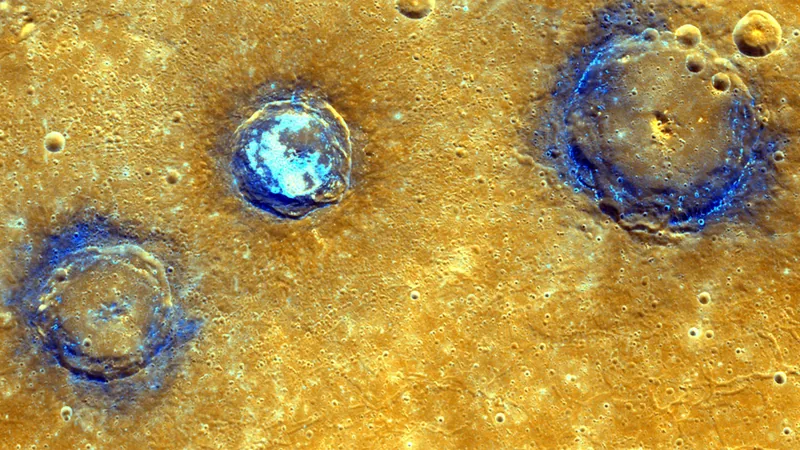
Caloris, in two kinds of colour
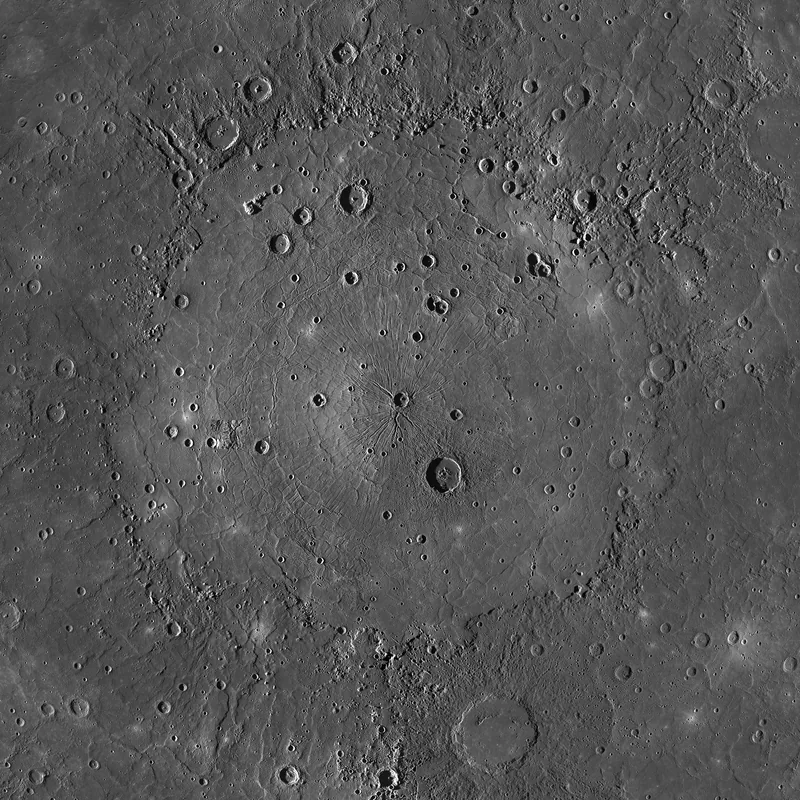
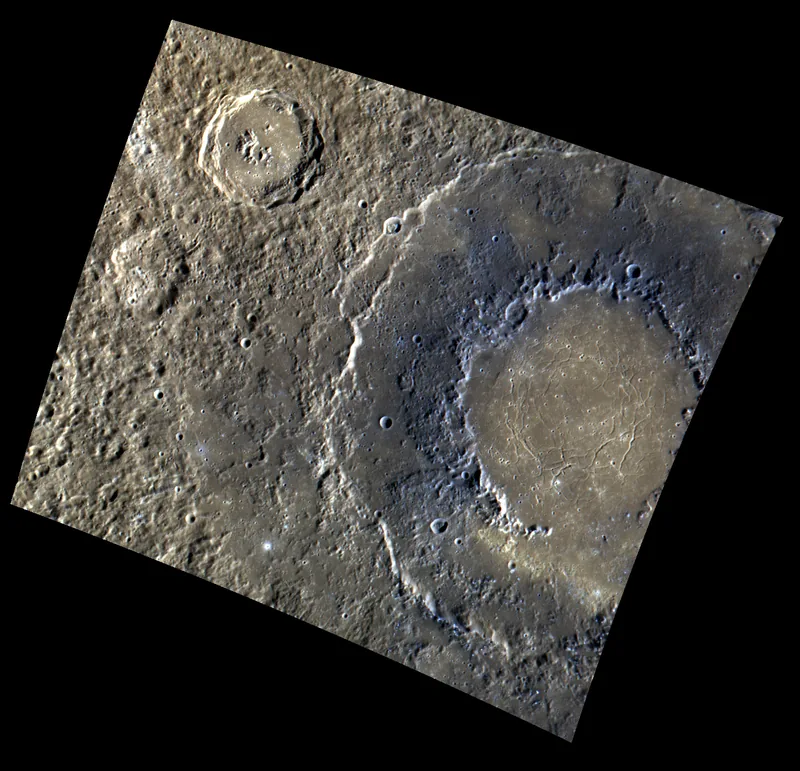
NASA Science gives the Caloris basin as 960 miles, or 1,550 kilometres, in diameter, created by an asteroid impact early in the solar system's history. Rachmaninoff, on the same page, is 190 miles, or 306 kilometres, across. [source] The orange still is PIA10359, and the file is blunt: it is a false-colour image. Caloris appears as a large, circular, orange feature. The contrast between the colours of the basin floor and the surrounding plains, the caption says, indicates that the composition of Mercury's surface is variable. The monochrome mosaic below is the same basin without that colour argument — a map, not a costume.
A shrinking world
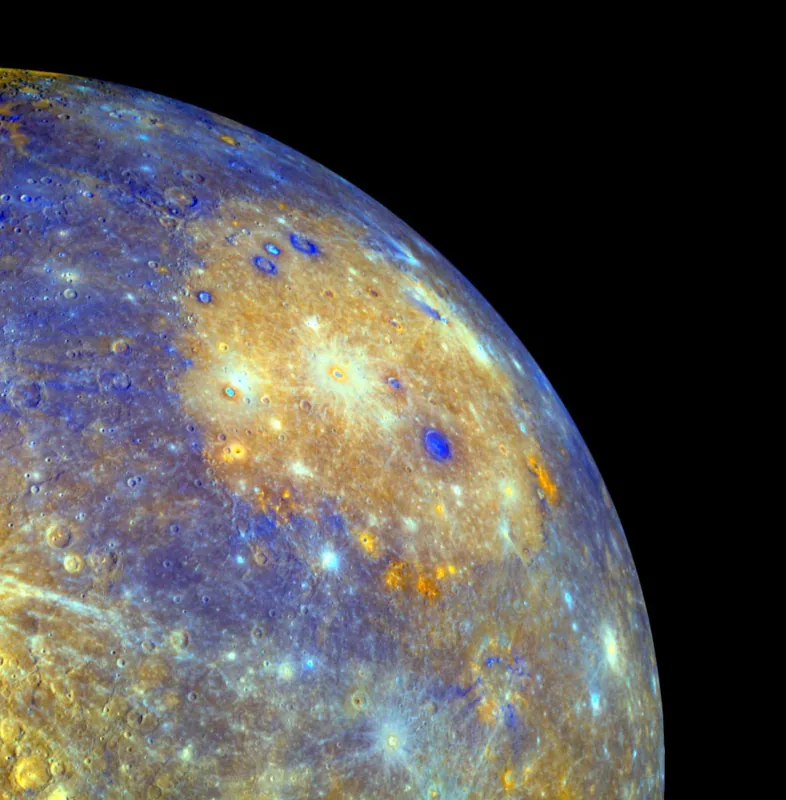
NASA Science says that while there are large areas of smooth terrain, there are also cliffs, some hundreds of miles long and soaring up to a mile high. They rose as the planet's interior cooled and contracted over the billions of years since Mercury formed. [source] Carnegie Rupes, with Duccio crater in the same frame, is one of those long wrinkles. The fact sheet's topographic range for the whole planet is 7 km, against 20 km for Earth, a ratio of 0.350. [source] A smaller range, on a smaller world, and still room for a cliff a mile high.
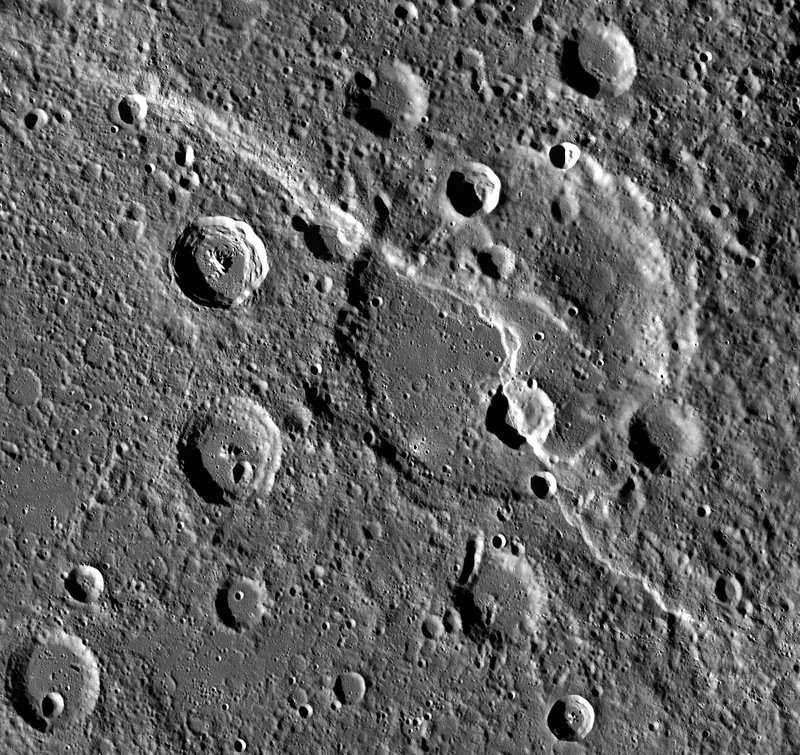
Most of Mercury's surface, NASA Science says, would appear greyish-brown to the human eye. The bright streaks are crater rays, crushed rock thrown out by impacts, more reflective than the older ground, and darkened over time by dust impacts and solar-wind particles. [source] Craters and features are named after famous deceased artists, musicians, or authors — including, on that official page, Dr Seuss and Alvin Ailey. Hence Truffaut, Rachmaninoff, Munch, Sander and Poe.
Under all of that sits a very large core. NASA Science calls Mercury the second densest planet, after Earth, with a large metallic core about 1,289 miles (2,074 kilometres) in radius, about 85% of the planet's radius, and an outer shell only about 400 kilometres (250 miles) thick. There is evidence, the same page says, that the core is partly molten or liquid. [source] The fact sheet's mean density is 5,429 kg/m3 against Earth's 5,513, a ratio of 0.985. [source] A small planet, almost as dense as Earth, with most of its radius given over to metal.
Enjoyed a day longer than a year, ice in the shadows, and hollows no one had named until MESSENGER looked closely?
No pop-ups. No intrusive advertising. Just interesting stuff. A little support helps the next planets.im site get built.