Myths versus facts
What Mercury is not, and what the official pages actually say
Closest is not hottest. A year is not a solar day. False colour is not a grey-brown landscape. The official sources are already more interesting than the shortcuts.
Myth: the closest planet is the hottest
NASA Science says it twice, in case anyone has carried that idea since school: despite its proximity to the Sun, Mercury is not the hottest planet in our solar system — that title belongs to nearby Venus, thanks to its dense atmosphere. [source] Mercury can still be ferocious in the sunlight. The same page gives day highs of 800°F (430°C) and night lows of -290°F (-180°C). Hottest is not the same as closest, and a thin exosphere does not keep the heat after sunset.
Myth: a day on Mercury is 88 Earth days, or 59, or perhaps 176
Those are three official kinds of clock, not three mistakes. The fact sheet's year is 87.969 days, the sidereal rotation 1,407.6 hours, and the length of day 4,222.6 hours. [source] NASA Science rounds them to 88, 59 and 176 Earth days. [source] A year is not a spin, and a spin is not a day-night cycle. The day desk keeps all three in view.
Myth: the official tilt is one tidy number
It is not. The fact sheet gives 0.034 degrees. [source] NASA Science says just 2 degrees. [source] This is not a quarrel for a comments section. It is two official pages, opened on the same day, saying two different things about the same axis. Both wordings are kept. Neither is silently corrected to the other.
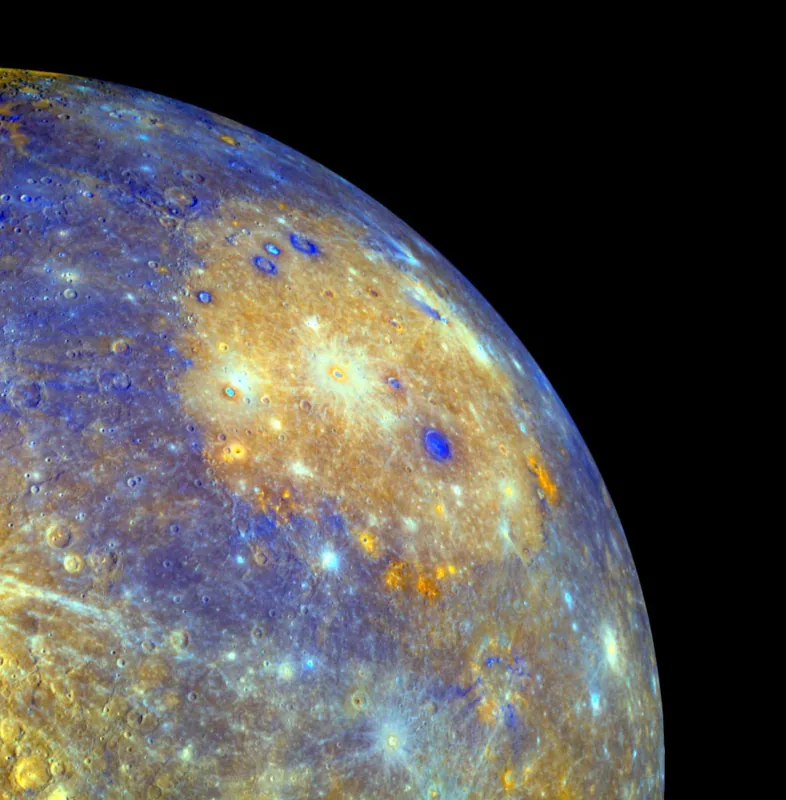
Myth: the orange Caloris picture is what you would see
The file says it is a false-colour image. The orange marks a difference in surface composition, not a rust-coloured landscape. NASA Science says most of the surface would appear greyish-brown to the human eye. Enhanced-colour stills, including Orange Is the New Blue, are labelled as enhanced on this desk.
Myth: the yellow at the pole is a photograph of ice
It is a radar overlay. PIA19411's own caption says the yellow regions mark locations that show evidence for water ice, as detected by Arecibo. NASA Science's claim is already careful: Mercury may have water ice, but only in permanent shadow. The map is evidence, not a snapshot of a frozen pond.
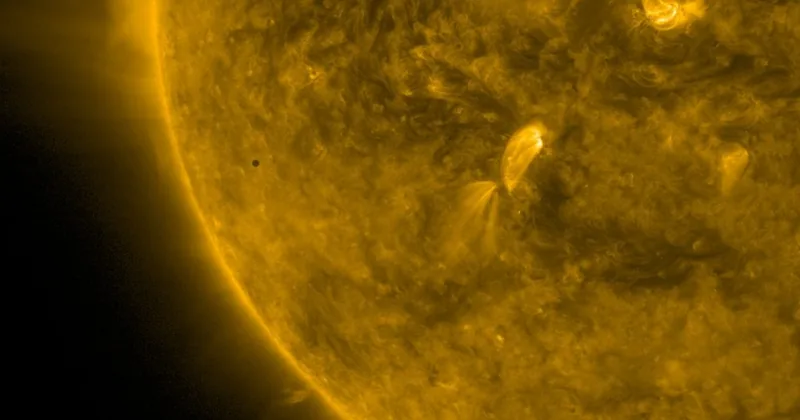
Myth: a transit of Mercury is safe to stare at
The SDO still on this site is a spacecraft picture. Official pages say never to look directly at the Sun without protecting your eyes. That sentence is quoted here, not turned into a how-to.
Enjoyed a day longer than a year, ice in the shadows, and hollows no one had named until MESSENGER looked closely?
No pop-ups. No intrusive advertising. Just interesting stuff. A little support helps the next planets.im site get built.