A polar surprise
Ice at the closest planet to the Sun
NASA Science says it out loud: Mercury may have water ice at both poles, but only in craters that never see the Sun. The yellow on the official map is radar evidence from Arecibo, laid on a MESSENGER view of the north pole.
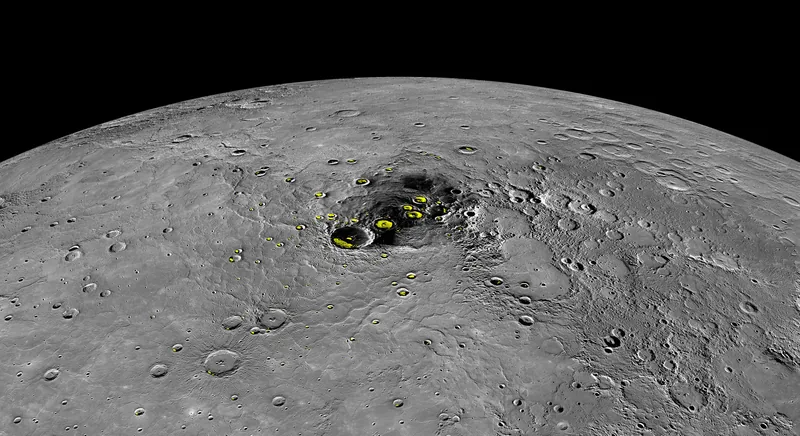
It is one of the least likely sentences on a desk about the closest planet to the Sun, and NASA Science still says it: Mercury may have water ice at its north and south poles inside deep craters, but only in regions in permanent shadows. In those shadows, it could be cold enough to preserve water ice despite the high temperatures on sunlit parts of the planet. [source]
The still above is PIA19411, released on 16 April 2015. The official caption is careful in a way this desk tries to be careful too. It is an orthographic projection of the north polar region. The yellow regions in many of the craters mark locations that show evidence for water ice, as detected by Earth-based radar observations from the Arecibo Observatory in Puerto Rico. The yellow is a radar result laid on a MESSENGER map. It is not a photograph of ice shining in the dark.
A world of extremes, officially told two ways
NASA Science gives the surface temperature extremes in public wording: day temperatures can reach highs of 800°F (430°C). Without an atmosphere to retain that heat at night, temperatures can dip as low as -290°F (-180°C). [source] The fact sheet does not put those night-side figures in the same table. It gives an average temperature of 440 K (167°C), and a sunward-side range of 590-725 K, under a surface-bounded exosphere whose surface pressure is <~5 × 10-15 bar. [source] The two official accounts are left distinct. One is a pair of rounded extremes on a public facts page. The other is a tabulated average, a sunward range, and a vacuum with a name.
NASA Science also says that, from the surface, the Sun would appear more than three times as large as it does from Earth, and the sunlight would be as much as seven times brighter. [source] The fact sheet's solar irradiance is 9,082.7 W/m2 against Earth's 1,361.0, a ratio of 6.674. [source] As much as seven times and 6.674 are the same comparison, rounded differently — and this desk will not pretend they are a different measurement.
Why the ice can last
The same facts page that gives the 800°F days also says Mercury's axis is tilted just 2 degrees, so the planet spins nearly perfectly upright. [source] The fact sheet's obliquity is 0.034 degrees. [source] Either official tilt is small enough that the floors of some polar craters never see the Sun. NASA Science's condition is plain: only in regions in permanent shadow. The surprise is not that Mercury is cold at night. It is that, on a world this close to the Sun, a few craters keep a night that does not end, and radar has found evidence of water ice there.
The clocks that make a Mercury day so long are on the day desk. The hollows, the scarps and Caloris are on the surface page.
Enjoyed a day longer than a year, ice in the shadows, and hollows no one had named until MESSENGER looked closely?
No pop-ups. No intrusive advertising. Just interesting stuff. A little support helps the next planets.im site get built.