Credits
Every photograph on this site
Licences were checked on each source page on 18 November 2026. Public-domain NASA and allied stills are used throughout. One still, where used, is CC BY 2.0 and is credited on this page.
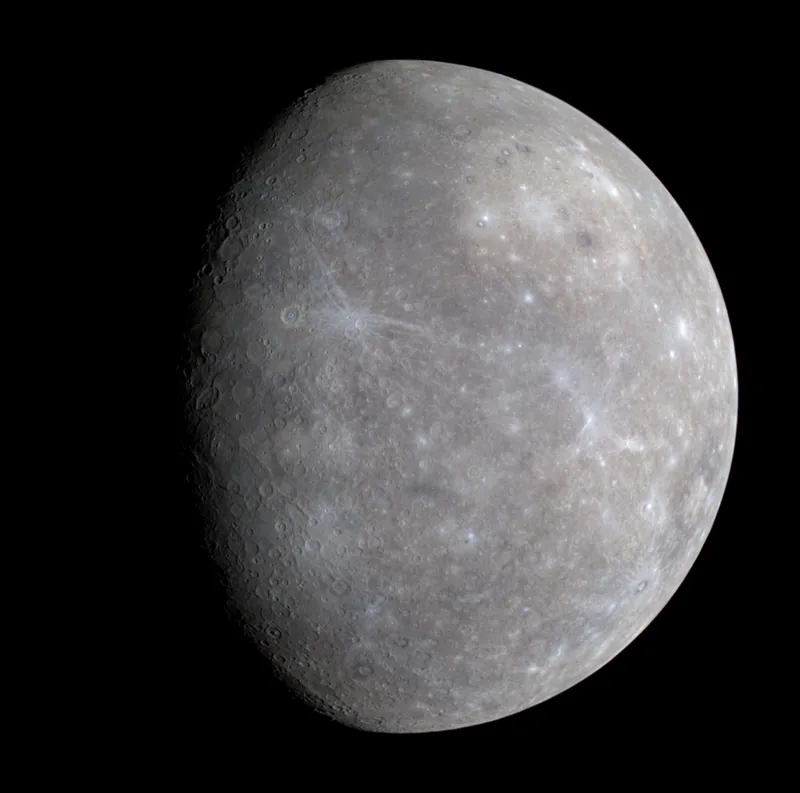
A full-colour image of Mercury from MESSENGER's first flyby. The Commons file dates the still to 30 January 2008 and describes it as a centred edit of the NASA/JHUAPL/Carnegie original. Public domain. Photo: NASA / Johns Hopkins University Applied Physics Laboratory / Carnegie Institution of Washington · Public domain · NASA/JHUAPL/CIW / Wikimedia Commons 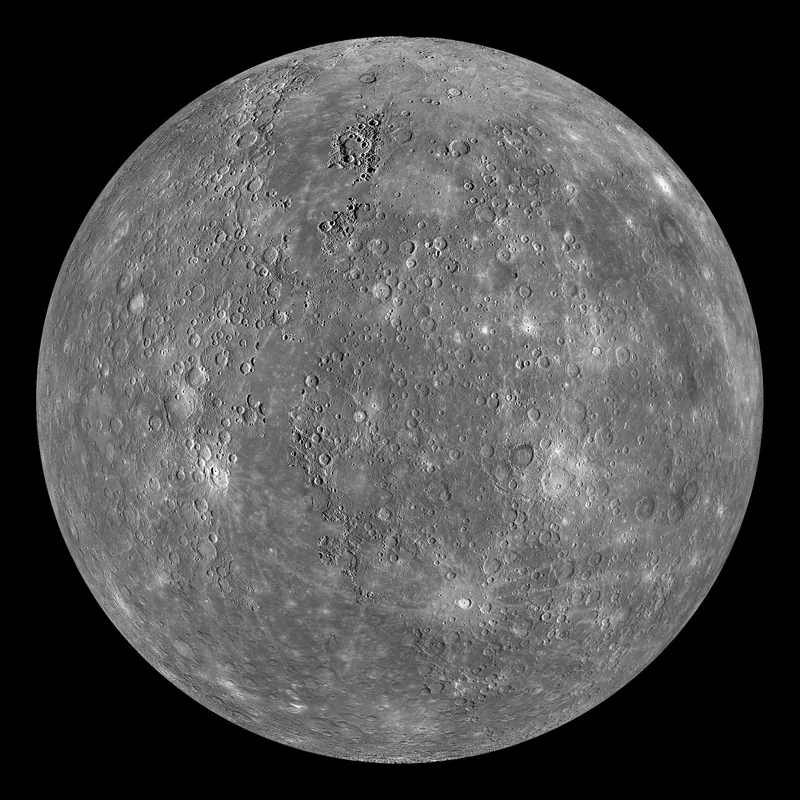
A MESSENGER global mosaic of Mercury, centred at 0 degrees north, 0 degrees east. A map of a world that, until the orbital campaign, had never been seen in full. Public domain. Photo: NASA / Johns Hopkins University Applied Physics Laboratory / Carnegie Institution of Washington · Public domain · NASA/JHUAPL/CIW / Wikimedia Commons 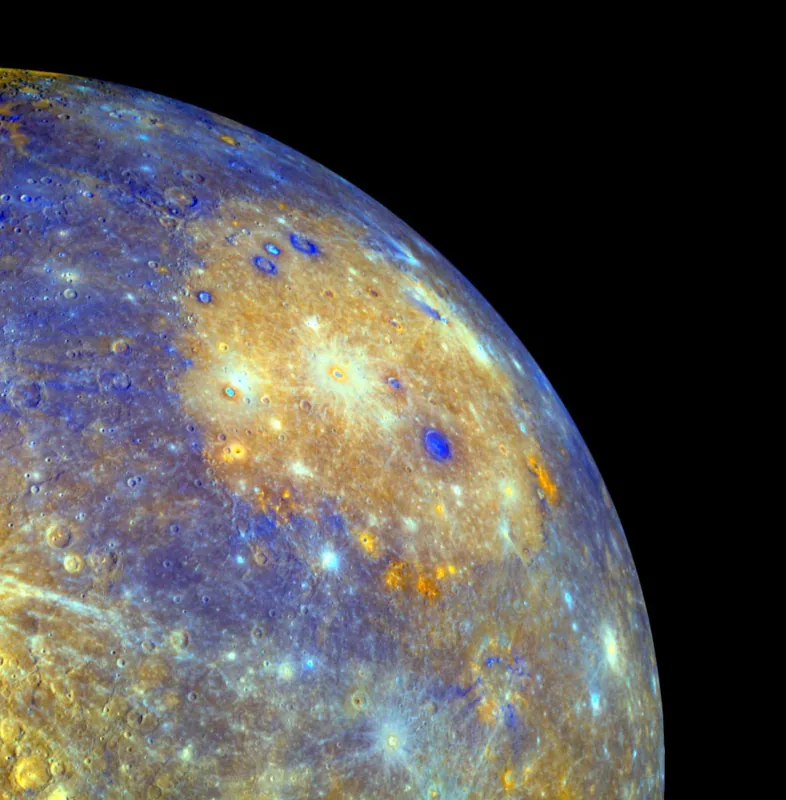
False colour, as the file itself says. The great Caloris impact basin is the large circular orange feature at the centre. The contrast with the surrounding plains, the caption says, indicates that the composition of Mercury's surface is variable. Image courtesy of Science/AAAS as well as the mission teams. Public domain. Photo: NASA / Johns Hopkins University Applied Physics Laboratory / Arizona State University / Carnegie Institution of Washington · Public domain · NASA/JHUAPL/ASU/CIW / Wikimedia Commons 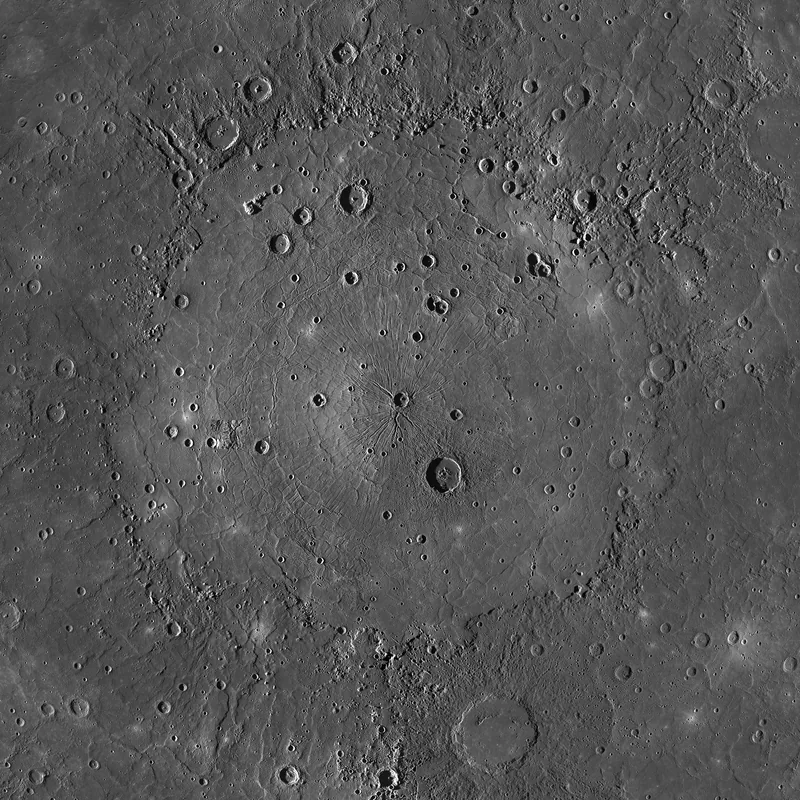
A MESSENGER mosaic of the Caloris basin, the same giant impact NASA Science gives as 960 miles, or 1,550 kilometres, across. This is a map of the basin in monochrome, not a colour interpretation. Public domain. Photo: NASA / Johns Hopkins University Applied Physics Laboratory / Carnegie Institution of Washington · Public domain · NASA/JHUAPL/CIW / Wikimedia Commons 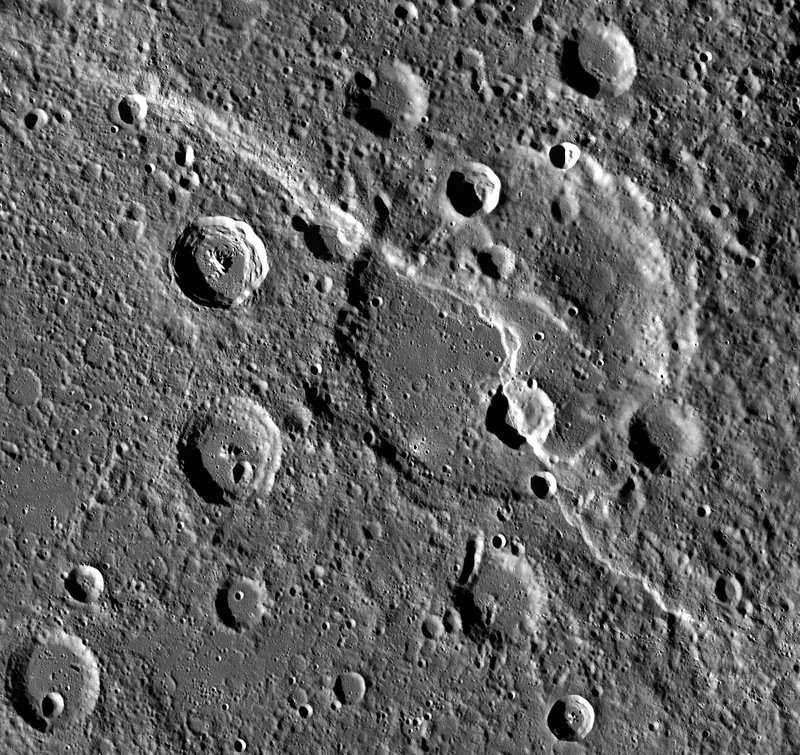
Carnegie Rupes and Duccio crater, in a MESSENGER still released as PIA19279. Scarps like this are the wrinkles of a world that cooled and contracted. NASA Science describes cliffs some hundreds of miles long and soaring up to a mile high, raised as the interior shrank. Public domain. Photo: NASA / Johns Hopkins University Applied Physics Laboratory / Carnegie Institution of Washington · Public domain · NASA/JHUAPL/CIW / Wikimedia Commons 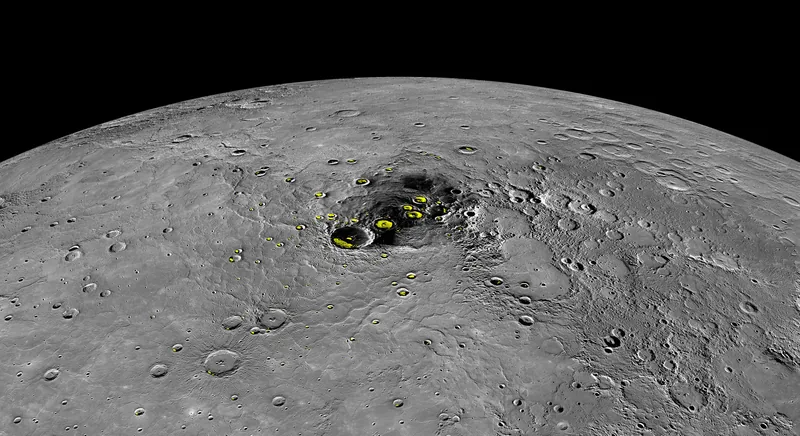
PIA19411, 16 April 2015. An orthographic view of Mercury's north polar region. The yellow patches mark locations that show evidence for water ice, as detected by Earth-based radar from the Arecibo Observatory. This is a MESSENGER map with a radar overlay, not a photograph of the ice itself. Public domain. Photo: NASA / Johns Hopkins University Applied Physics Laboratory / Carnegie Institution of Washington · Public domain · NASA/JHUAPL/CIW / Wikimedia Commons 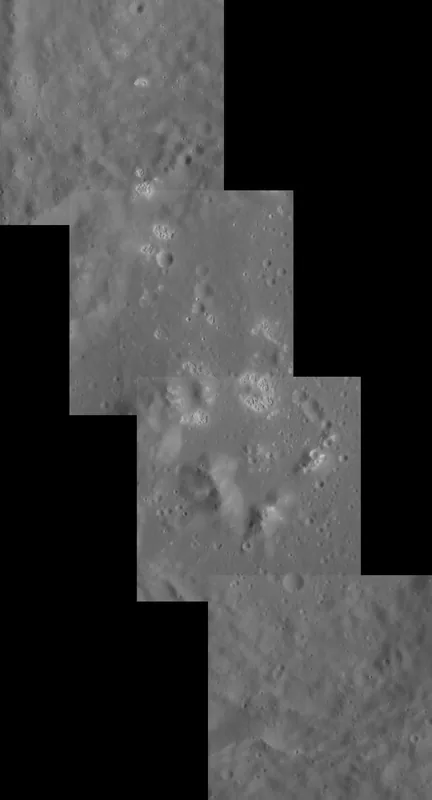
Hollows inside Truffaut crater, in a MESSENGER Narrow Angle Camera mosaic. A NASA Science resource dated 29 February 2012 says MESSENGER discovered strange hollows, peculiar depressions from 60 feet to over a mile across and 60 to 120 feet deep. Public domain. Photo: NASA / Johns Hopkins University Applied Physics Laboratory / Carnegie Institution of Washington · Public domain · NASA / Wikimedia Commons 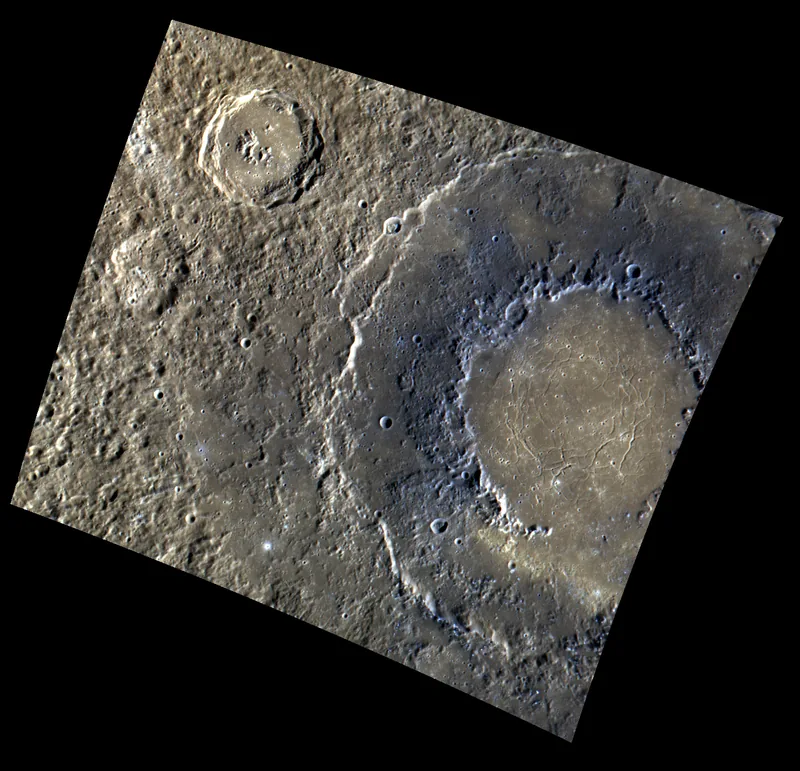
Rachmaninoff, a peak-ring basin on Mercury, in a three-filter colour composite. NASA Science gives this basin as 190 miles, or 306 kilometres, in diameter. Public domain. Photo: NASA / Johns Hopkins University Applied Physics Laboratory / Carnegie Institution of Washington · Public domain · NASA/JHUAPL/CIW / Wikimedia Commons 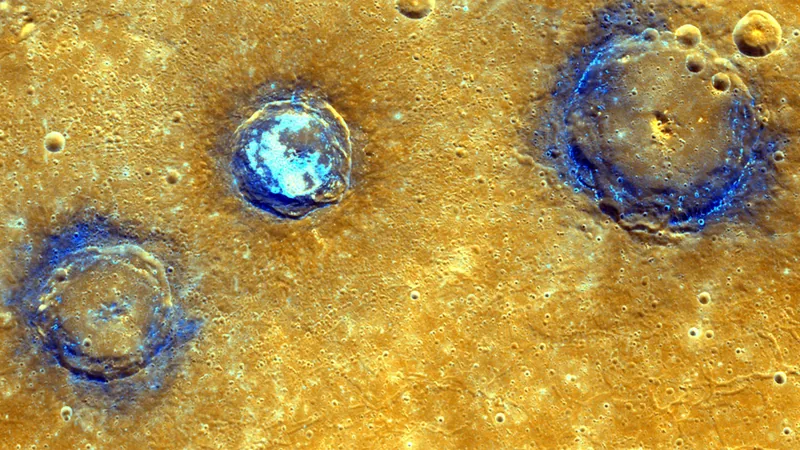
PIA19421, titled Orange Is the New Blue. Enhanced colour, not what the eye would see: from left to right, Munch, Sander and Poe, in the northwest of Caloris. The official caption says the smooth volcanic plains that fill the basin appear orange in this treatment. Public domain. Photo: NASA / Johns Hopkins University Applied Physics Laboratory / Carnegie Institution of Washington · Public domain · NASA/JHUAPL/CIW / Wikimedia Commons 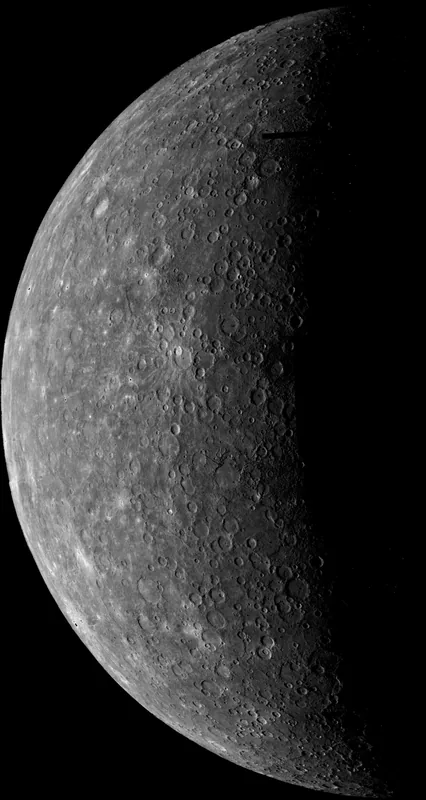
Mariner 10's first image of Mercury, acquired on 24 March 1974 from 3,340,000 miles (5,380,000 km). The official caption on the file gives Mercury's diameter as 3,031 miles. A first look, from a long way off, at the closest planet to the Sun. Public domain. Photo: NASA / JPL / USGS · Public domain · NASA/JPL/USGS / Wikimedia Commons 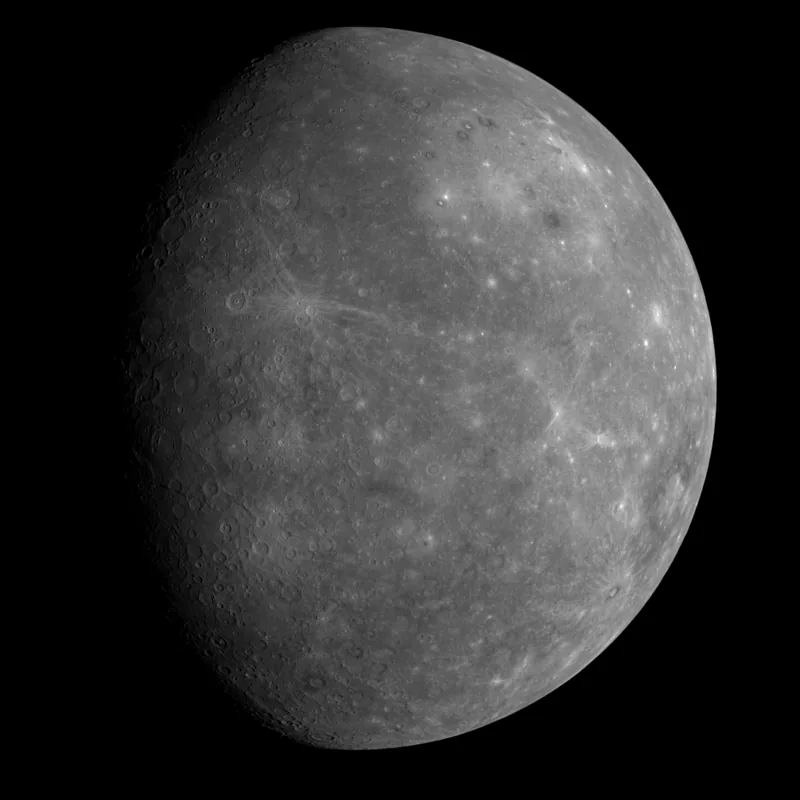
MESSENGER's first photograph of the side of Mercury that Mariner 10 never saw. After three flybys in the 1970s, almost half the planet had remained a blank. This is the start of filling it in. Public domain. Photo: NASA / Johns Hopkins University Applied Physics Laboratory / Carnegie Institution of Washington · Public domain · NASA/JHUAPL/CIW / Wikimedia Commons 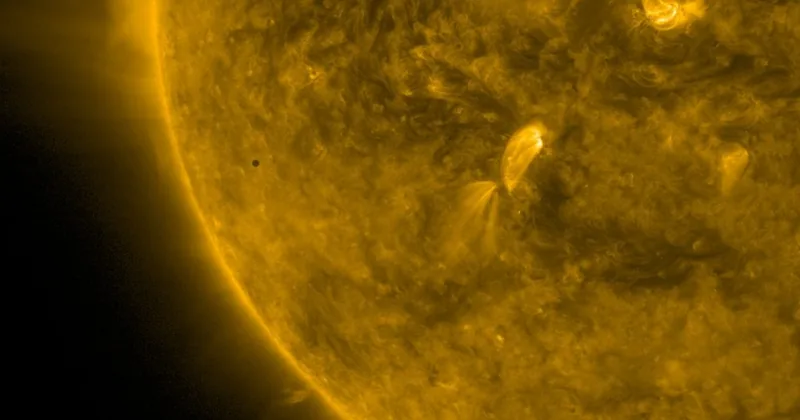
A transit of Mercury on 9 May 2016, photographed by NASA's Solar Dynamics Observatory in the 17.1 nm channel. Mercury is the small dark disk on the face of the Sun — a reminder of scale, and not a thing to look at with the unprotected eye. Official pages say never to look directly at the Sun without protecting your eyes. Public domain. Photo: NASA / SDO · Public domain · NASA/SDO / Wikimedia Commons
Enjoyed a day longer than a year, ice in the shadows, and hollows no one had named until MESSENGER looked closely?
No pop-ups. No intrusive advertising. Just interesting stuff. A little support helps the next planets.im site get built.